
What happens when someone visits your physiotherapy clinic website at 10:30 PM and wants to book an appointment?
Your receptionist has finished work. Your clinic is closed. But the prospective patient is still searching for information.
They may want to know whether your clinic offers physiotherapy, chiropractic care, sports injury rehabilitation or another service.
They might also have questions about your location, opening hours, direct billing or appointment availability.
Traditionally, their options would be to browse the website, use an existing online booking system, leave a message or wait until the next business day.
A 24/7 AI Patient Enquiry & Booking Assistant can add another option: an interactive digital assistant that provides approved clinic information, guides visitors toward booking and supports appropriate follow-up.
In this guide, we explain how an AI patient booking assistant for physiotherapy clinics works, where it can add value, what it should never do, and how Canadian clinics can evaluate the technology responsibly.
1. What Is a 24/7 AI Patient Enquiry & Booking Assistant?
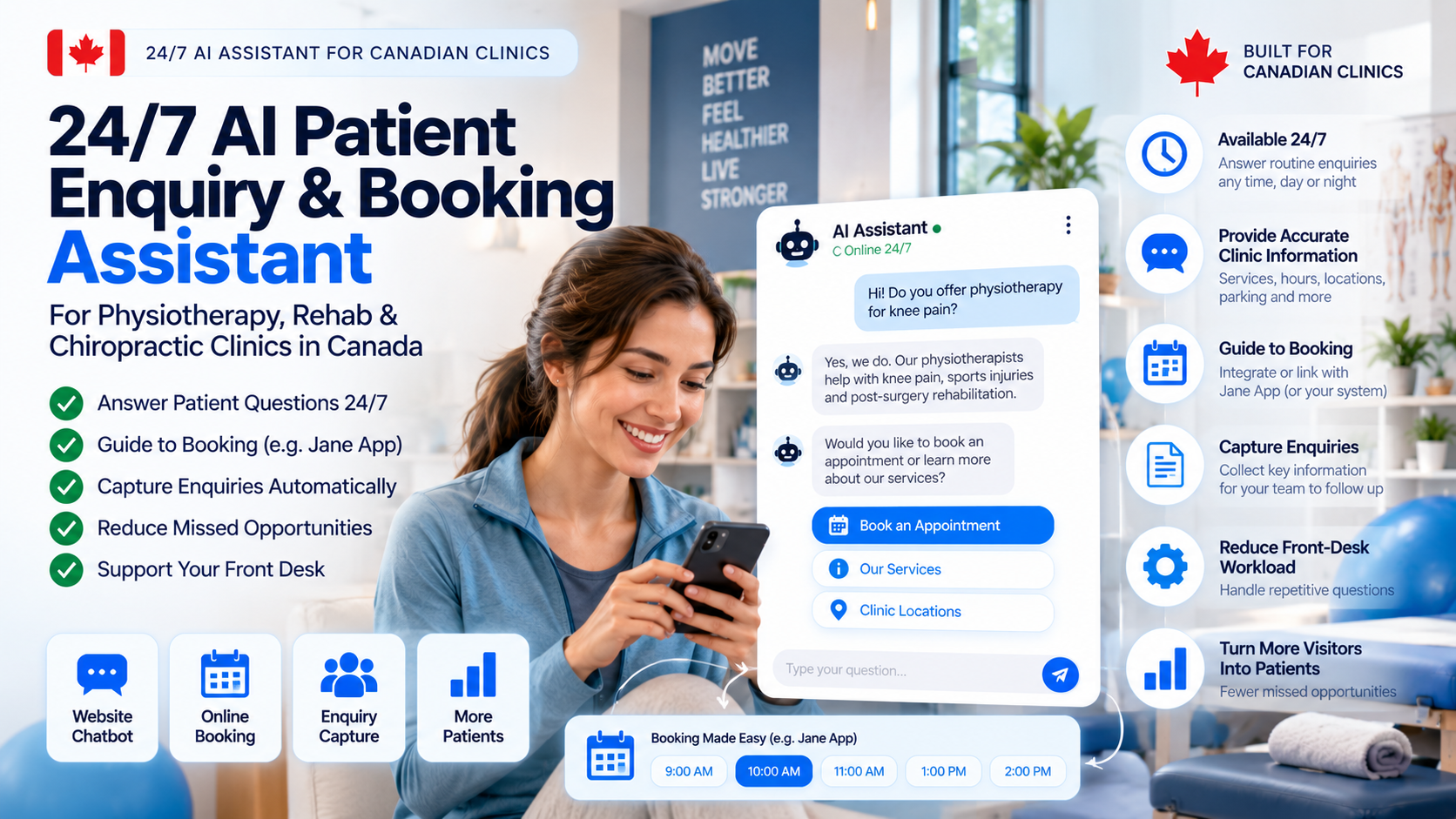
A 24/7 AI Patient Enquiry & Booking Assistant is a website-based conversational tool designed to help prospective and existing patients with approved administrative information.
Unlike a traditional contact form, a conversational assistant allows visitors to ask questions in natural language.
For example:
- Do you offer physiotherapy for sports injuries?
- Where is your clinic located?
- Are you open on Saturdays?
- Do you provide chiropractic services?
- How can I book my first appointment?
- Do you offer direct billing?
- Can someone contact me tomorrow?
The assistant can respond using information approved by the clinic.
Depending on the configuration, it may also guide visitors to an existing booking platform or capture limited contact information for staff follow-up.
An AI enquiry assistant does not automatically mean an AI receptionist that answers telephone calls.
A website chatbot, a voice-based AI receptionist and a directly integrated appointment-booking system are different solutions with different technical requirements and costs.
2. Why After-Hours Patient Enquiries Matter
Healthcare enquiries do not always happen during regular business hours.
A prospective patient might search for a clinic after work, during a lunch break or on the weekend.
If they cannot quickly find the information they need, they may leave without taking another step.
An AI assistant can help make approved information available when reception is closed.
However, this does not mean every after-hours visitor represents a lost patient or that installing AI guarantees additional bookings.
The potential benefit depends on visitor demand, the quality of the website, the assistant's accuracy and how effectively the clinic follows up.
Example: A Sunday Evening Enquiry
Imagine someone visits a physiotherapy clinic website on Sunday evening.
They want to know whether the clinic provides sports injury rehabilitation.
The AI assistant can:
- Identify the visitor's administrative question.
- Explain whether the clinic lists that service.
- Provide the relevant service-page link.
- Offer a link to the clinic's booking platform.
- Offer an enquiry form for staff follow-up if needed.
The visitor receives useful information without waiting for reception to reopen.
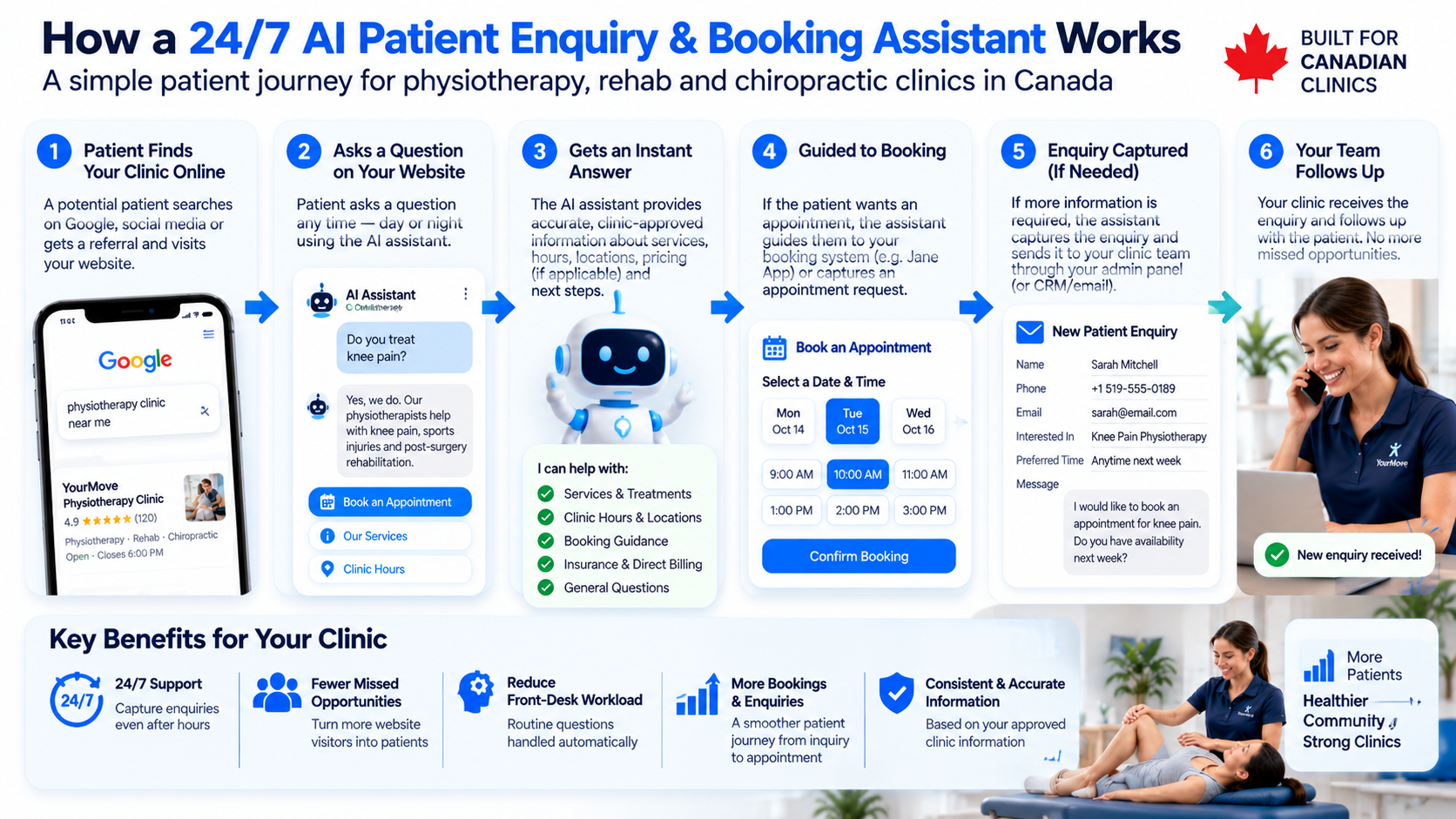
3. How the AI Patient Assistant Works: Step by Step
A well-designed assistant should follow a predictable workflow.
Step 1: A Visitor Arrives on the Clinic Website
The visitor may come from Google Search, Google Maps, social media, an advertisement or a referral.
The assistant is available on relevant pages of the clinic website.
Step 2: The Visitor Asks a Question
The visitor can ask a routine administrative question using everyday language.
For example:
"Do you offer chiropractic appointments on weekends?"
Step 3: The Assistant Uses Approved Clinic Information
The assistant should retrieve or use information from an approved clinic knowledge base.
This may include:
- Services offered
- Clinic locations
- Business hours
- Contact details
- Booking instructions
- General payment information
- Approved administrative FAQs
If the information is unavailable or uncertain, the assistant should avoid inventing an answer.
Step 4: The Assistant Guides the Visitor
Based on the enquiry, the assistant can direct the visitor toward the appropriate service page, location, booking link or contact option.
Step 5: Booking Handoff or Enquiry Capture
If the clinic uses an online booking platform, the assistant can provide the appropriate booking link.
If the visitor prefers follow-up, the assistant may offer to collect minimal contact details with an appropriate privacy notice.
Step 6: Staff Follow-Up When Required
Enquiries that cannot be completed automatically should be directed to authorized clinic staff.
Depending on the system, this might involve an administrative dashboard, approved email notification or a supported CRM workflow.
Step 7: The Clinic Reviews Performance
The clinic can review appropriately collected operational metrics to understand which questions visitors ask and where improvements may be needed.
4. What Questions Can a Physiotherapy AI Chatbot Answer?
The most useful starting point is often the clinic's existing list of repetitive administrative questions.
| Patient Question | Appropriate AI Support |
|---|---|
| What are your opening hours? | Provide verified clinic hours. |
| Where are you located? | Provide the approved address and directions link. |
| Do you offer chiropractic care? | Explain whether the service is listed by the clinic. |
| How can I book an appointment? | Provide the approved booking link or instructions. |
| Do you offer direct billing? | Share approved general billing information without guaranteeing coverage. |
| Can someone call me tomorrow? | Offer an appropriate enquiry form and staff follow-up workflow. |
| What treatment should I receive? | Do not recommend treatment; direct the visitor to a qualified clinician. |
This approach helps establish clear expectations for both patients and clinic administrators.
5. Can an AI Assistant Work With Jane App?
Many Canadian physiotherapy, chiropractic and rehabilitation clinics use online practice-management and appointment-booking platforms.
Jane is one example.
There are two important levels of functionality.
Option A: Booking Link Handoff
This is the simpler approach.
The assistant answers approved administrative questions and directs the visitor to the clinic's existing Jane online booking page.
The actual appointment selection and booking take place inside Jane.
This does not require the AI assistant to independently create an appointment.
Option B: Direct Booking Integration
A deeper integration might involve checking availability, selecting an appointment or creating booking records.
However, these capabilities should never be assumed.
They depend on the booking provider's supported integration methods, permissions, technical documentation and the clinic's configuration.
Confirm the booking platform's current supported capabilities, permitted data access, authentication requirements and privacy responsibilities.
If those requirements cannot be verified, use a booking-link handoff instead.
Clinics can review Jane's official website for information about its practice-management and online booking services:
6. Can an AI Assistant Replace a Clinic Receptionist?
That should not be the objective.
A receptionist performs many responsibilities that go beyond answering basic website questions.
These may include sensitive conversations, complex scheduling, patient support, administrative judgement and coordination with healthcare professionals.
An AI assistant is better positioned as a supporting tool for approved, repetitive administrative interactions.
Tasks AI May Support
- Answering routine administrative FAQs
- Providing clinic hours and locations
- Explaining listed services
- Guiding visitors toward online booking
- Capturing appropriate follow-up requests
- Directing complex questions to staff
Tasks That Should Remain With Qualified Humans
- Medical diagnosis
- Individual treatment recommendations
- Clinical triage requiring professional judgement
- Interpretation of sensitive medical information
- Complex patient complaints
- Decisions requiring clinical expertise
The assistant should also clearly identify itself as an AI system rather than pretending to be a human receptionist or clinician.
7. Patient Privacy and AI: What Canadian Clinics Should Consider
Privacy is one of the most important considerations when introducing AI into a healthcare-related website.
Canadian clinics may be subject to federal and/or provincial privacy legislation depending on their activities, location and the information involved.
Health information is particularly sensitive.
Before deployment, clinics should review:
- What personal information the assistant collects
- Whether collecting that information is necessary
- How consent and privacy notices are presented
- Where conversations and enquiries are stored
- Which vendors process the information
- Who can access the records
- How long information is retained
- How records are secured and deleted
- Whether information crosses national borders
- How patients can reach clinic staff
The Office of the Privacy Commissioner of Canada publishes guidance on privacy responsibilities and the handling of personal information.
Its official guidance on meaningful consent is particularly relevant when evaluating how digital systems collect and use personal information.
Office of the Privacy Commissioner — Guidelines for Obtaining Meaningful Consent
Configure the assistant to avoid requesting detailed medical histories, diagnoses or other unnecessary sensitive information through a general website chat.
When a visitor raises a clinical concern, the assistant should direct them to qualified healthcare staff rather than independently interpreting symptoms.
Urgent or emergency situations should be directed to appropriate emergency services rather than handled as routine booking enquiries.
Privacy requirements are jurisdiction-specific. Clinics should obtain qualified privacy and legal review before deploying systems that process patient information.
8. What Should Happen When the AI Does Not Know an Answer?
An AI assistant should not be rewarded for confidently answering every question.
Sometimes the correct response is to acknowledge uncertainty.
For example:
"I can help with general clinic information and appointment guidance. For questions requiring clinical advice or confirmation from our team, please contact the clinic directly. I can also help you find the appropriate contact or booking option."
A reliable implementation should include:
- Approved knowledge sources
- Clearly defined prohibited topics
- Fallback responses
- Human escalation
- Regular information updates
- Testing against misleading or ambiguous questions
These safeguards are important because AI-generated responses can be inaccurate even when they sound confident.
For broader risk-management principles, the US National Institute of Standards and Technology publishes its official AI Risk Management Framework.
9. What About Physiotherapy, Chiropractic and Rehabilitation Clinics?
The core assistant can be similar across these clinic types, but the approved knowledge base should reflect each organization's actual services and workflows.
Physiotherapy Clinics
Potential use cases include general service enquiries, practitioner information, appointment guidance, clinic locations and administrative questions.
Chiropractic Clinics
The assistant may provide approved information about clinic services, opening hours, practitioner profiles and online booking.
Rehabilitation Clinics
For clinics offering several rehabilitation services, the assistant can help visitors navigate the website and identify which administrative contact or booking pathway is relevant.
In every case, the assistant should avoid deciding which treatment a patient medically requires.
10. How Much Does a 24/7 AI Patient Assistant Cost?
Pricing varies depending on the assistant's capabilities and the complexity of the clinic's requirements.
Important cost factors include:
- Number of clinic locations
- Size of the approved knowledge base
- Website integration requirements
- Lead capture and dashboard functionality
- Booking-link handoff versus direct integration
- Multilingual requirements
- Security and privacy requirements
- Maintenance and ongoing support
A basic website enquiry assistant is generally a different scope from a fully integrated AI receptionist with live scheduling or telephone functionality.
Clinics should request a clear written proposal identifying setup costs, recurring charges, included features, support responsibilities and any usage limits.
11. How Should Clinics Measure AI Assistant Performance?
Installing an assistant is not the same as proving that it improves clinic operations.
Useful metrics may include:
- Number of assistant conversations
- Percentage of conversations occurring after hours
- Common administrative questions
- Booking-link clicks
- Appropriate enquiry submissions
- Staff follow-up completion
- Escalation frequency
- Incorrect or unanswered responses
- Patient feedback where appropriately collected
For stronger attribution, clinics should distinguish between a booking-link click, an actual completed booking and a new patient appointment.
Those are not interchangeable outcomes.
12. Ten Questions to Ask Before Buying an AI Clinic Assistant
- What exact administrative tasks will the assistant perform?
- Where does the assistant obtain its answers?
- Can clinic staff update approved information?
- How are clinical and sensitive questions handled?
- What personal information is collected and stored?
- Where is the information processed and hosted?
- Does the assistant actually book appointments or only provide a booking link?
- How are enquiries transferred to clinic staff?
- What happens if the assistant gives an incorrect answer?
- What setup, recurring, usage and support charges apply?
These questions can help clinic owners compare solutions based on practical functionality rather than marketing claims.
13. Why Your Clinic Website Still Matters
An AI assistant should complement a well-structured website, not compensate for missing service information, confusing navigation or broken booking links.
Before implementing AI, review whether visitors can easily find:
- Services
- Practitioners
- Locations
- Hours
- Booking options
- Contact information
- Relevant administrative policies
For a complete website checklist, read our companion article:
Physiotherapy Clinic Website Design in Canada: 15 Essentials for 2026
14. Frequently Asked Questions
Can an AI Assistant Book Physiotherapy Appointments?
It can guide patients to an existing booking system.
Creating appointments directly requires a supported integration and appropriate permissions. That functionality should be verified before being promised.
Can a Physiotherapy AI Chatbot Work 24/7?
A properly hosted digital assistant can be configured for continuous availability, subject to system uptime, maintenance and service interruptions.
This does not mean clinical staff are available around the clock.
Can AI Answer Questions About Treatment?
An assistant may provide clinic-approved general information about listed services.
It should not independently diagnose conditions, recommend individualized treatment or replace qualified clinical judgement.
Will AI Automatically Increase Patient Bookings?
No.
An assistant may improve access to information and reduce friction in the enquiry process, but results depend on website traffic, patient demand, the booking experience, assistant quality and staff follow-up.
Can the Assistant Support Multiple Clinic Locations?
Yes, if configured with accurate location-specific information and appropriate routing.
Each clinic's services, practitioners, hours and booking links should be verified.
Does an AI Assistant Replace Jane App?
Not necessarily.
A website assistant can complement an existing booking platform by answering approved questions and directing visitors to the correct booking experience.
Is an AI Patient Assistant the Same as an AI Voice Agent?
No.
A website assistant handles online conversations. A voice agent interacts through telephone or voice channels and introduces additional telephony, consent, privacy and integration considerations.
15. How to Start With an AI Patient Enquiry Assistant
A sensible implementation does not need to begin with a complex system.
For many clinics, the first stage can focus on:
- Identifying repetitive administrative enquiries.
- Preparing an approved clinic information library.
- Adding a website-based assistant.
- Connecting existing booking links.
- Providing an appropriate enquiry form.
- Establishing human escalation procedures.
- Testing the assistant before public launch.
- Reviewing performance and improving answers over time.
More advanced functionality can be considered only when there is a clear operational requirement and the necessary technical and privacy controls are available.
Final Thoughts
A 24/7 AI Patient Enquiry & Booking Assistant should be evaluated as a practical clinic-support tool—not simply as another AI feature.
Its purpose is to make approved administrative information easier to access, guide prospective patients toward appropriate next steps and support clinic staff with routine enquiries.
The strongest implementations combine useful website content, accurate clinic information, straightforward booking options, privacy-conscious workflows and clear human oversight.
For physiotherapy, rehabilitation and chiropractic clinics, that is a more sustainable starting point than promising that AI will replace receptionists or automatically generate new patients.
Authoritative External References
The following official resources provide additional information about privacy, responsible AI, accessibility, website quality and booking systems.
-
Office of the Privacy Commissioner of Canada — Guidelines for Obtaining Meaningful Consent
Read official Canadian privacy guidance -
Office of the Privacy Commissioner of Canada — Official Website
Canadian privacy regulator -
NIST — AI Risk Management Framework
Read the official AI risk-management framework -
Google Search Central — Creating Helpful, Reliable, People-First Content
Read Google's official content guidance -
W3C — Web Content Accessibility Guidelines
Read official accessibility standards -
Jane — Official Practice Management and Booking Platform
Visit Jane's official website
These references support general educational information. They do not establish that any particular AI implementation meets applicable legal, clinical or privacy requirements.
See How a 24/7 AI Patient Assistant Could Work for Your Clinic
HiTech Consultancy helps Canadian physiotherapy, rehabilitation and chiropractic clinics explore practical website and AI automation solutions.
Our 24/7 AI Patient Enquiry & Booking Assistant can be configured to support approved administrative questions, guide visitors toward booking and capture appropriate enquiries for follow-up.
Want to see how it could fit your clinic's existing website and booking workflow?